FBR POS Integration in 2026: Who Must Connect, How It Works, and Choosing Software
If you run a large shop, a branch of a chain, or a store inside an air-conditioned mall, FBR POS integration is not optional. FBR expects every sale rung up at your counters to reach its system in real time, and your customers can check whether the receipt in their hand is genuine. This guide explains in plain language who must integrate, where the rules come from, how the technical side works, and how to choose a licensed integrator or software without overpaying.
Disclaimer
This article is for information only and is not legal or tax advice. Always confirm the latest notifications on fbr.gov.pk or with your tax advisor, because rules and categories are revised from time to time.
What is FBR POS integration?
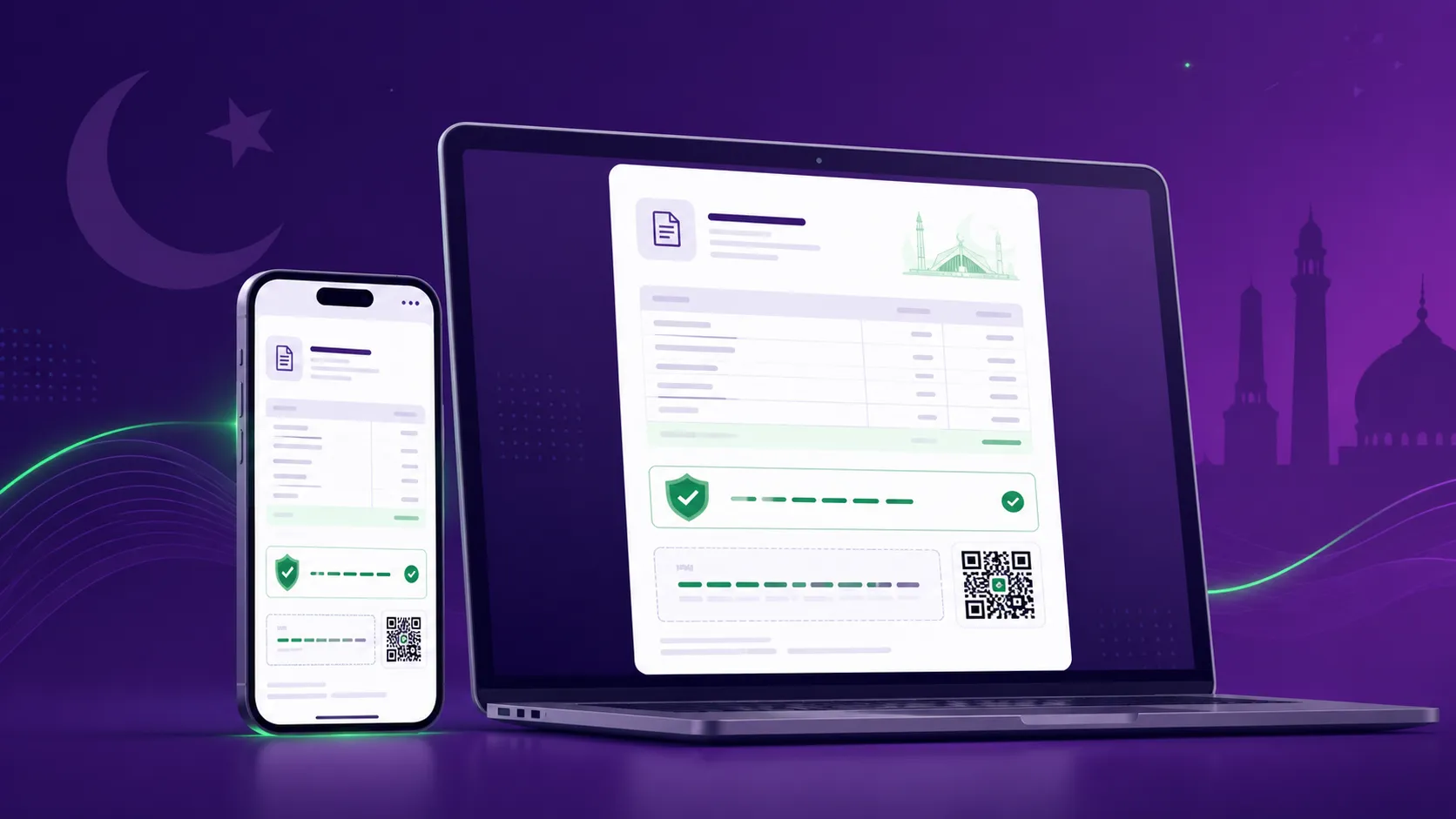
FBR POS integration means connecting the point of sale (POS) system at each of your counters to FBR, so that every sale is reported the moment it happens. Instead of totalling your sales at month end and declaring them later, the transaction itself is recorded with FBR when the customer pays. The receipt your customer receives then carries an FBR invoice number that can be verified independently.
It is part of the same documentation drive as FBR digital invoicing for business-to-business sales. POS integration began with retailers selling to end consumers, while the wider digital invoicing mandate now covers almost every sales tax registered person. If you also issue invoices to registered buyers, read our complete guide to FBR digital invoicing alongside this one.
Who must integrate: Tier-1 retailers
The POS integration requirement applies to Tier-1 retailers. Under the sales tax rules, Tier-1 includes:
- Units of national or international chains of stores.
- Retailers operating in air-conditioned shopping malls or plazas. Kiosks are not included.
- Retailers whose electricity bill exceeded Rs 1.2 million in the preceding 12 months.
- Any other category of retailer that FBR notifies.
The electricity test catches many businesses by surprise. A single large store with heavy cooling and lighting can cross the threshold without being part of a chain or a mall. If your electricity bills over the preceding 12 months add up to more than Rs 1.2 million, treat yourself as Tier-1 and plan accordingly.
Every counter that takes payment
Integrating one till is not enough. Every counter that receives payment must be connected. If you have five tills on the shop floor and a separate payment desk for bulk orders, all six need to report to FBR. Keeping one "manual" counter for cash sales leaves a gap in your compliance.
The legal basis: from Chapter XIV-AA to Chapter XIV
Real-time POS integration for Tier-1 retailers was introduced by SRO 1360(I)/2018 as Chapter XIV-AA of the Sales Tax Rules, 2006. In January 2025, SRO 69(I)/2025 completely replaced Chapter XIV, setting new rules for integrator licensing, integration and e-invoice issuance, and merged Chapter XIV-AA into it. In practice this means POS integration and digital invoicing now sit under one framework, with the same idea of licensed integrators connecting your systems to FBR.
| Notification | What it did for POS integration |
|---|---|
| SRO 1360(I)/2018 | Added Chapter XIV-AA: mandatory real-time POS integration for Tier-1 retailers |
| SRO 69(I)/2025 | Replaced Chapter XIV and merged Chapter XIV-AA into it, with new rules on licensed integrators |
| STGO 01 of 2026 | Confirmed a business may use one or several licensed integrators, and limited invoice corrections to 72 hours |
For the full list of notifications, including the phased digital invoicing deadlines, see every SRO, deadline, and penalty explained.
How customers verify your receipts
One reason FBR pushes POS integration so hard is that it turns every customer into a checker. A buyer can verify a receipt in two ways:
- Check it in FBR's Tax Asaan app.
- SMS the invoice number printed on the receipt to 9966.
If the number does not come back as valid, the customer knows the sale was not reported. For a retailer, that is both a compliance risk and a reputation risk. A receipt that fails verification looks worse than no receipt at all.
FBR POS integration API and technical documentation
Business owners do not need to read API specifications, but it helps to know what your vendor is working with. For digital invoicing, PRAL publishes a technical specification (the DI API, currently version 1.12) and FBR makes the technical documentation available on its Digital Invoicing Technical Assistance page. The key points are:
- The API runs on PRAL's Enterprise Service Platform (ESP) and works in real time over a Web API.
- Each request carries a security token issued by PRAL, sent in the Authorization header as "Bearer" followed by the token. The token is valid for 5 years.
- The same URLs serve sandbox and production. The token you use decides where the call goes.
- Invoices are sent to the post method and FBR replies with an FBR invoice number, or with an error code explaining what is wrong.
- Reference APIs return official lists such as provinces, units of measurement, HS code and UOM pairs, sale types and rates, and SRO items, so your system uses FBR's own values.
The specification also includes three scenarios written for retailers: SN026, SN027 and SN028, which cover sales to end consumers by retailers at the standard rate, for 3rd Schedule goods and at a reduced rate. These apply only if you are registered as a retailer in your sales tax profile. If your profile is wrong, these scenarios will not work for you, so check it on IRIS before testing.
Printing rules
The Digital Invoicing System logo and QR code must be printed on each invoice. FBR's specification sets the QR code at version 2.0 (25×25) and 1.0 × 1.0 inch, and asks you to use the FBR Digital Invoicing System image as supplied. Make sure your receipt printer layout leaves room for both.
FBR POS integration vendor list: choosing a licensed integrator
Searches for an "FBR POS integration vendor list" usually come from retailers trying to work out who they are allowed to use. The rules are simpler than they look:
- Your connection to FBR must run through a licensed integrator. A licensed integrator is an entity licensed under Chapter XIV to connect registered persons' systems with FBR.
- PRAL itself acts as a licensed integrator free of cost under Rule 150XF.
- Configuration fees charged by other licensed integrators are capped by FBR, so be wary of quotes that look far above the market.
- Under STGO 01 of 2026 you may use one licensed integrator or several, which helps if different branches run different systems.
Before signing with any POS vendor, ask for written confirmation that they are a licensed integrator, or which licensed integrator they connect through, and confirm it with FBR or your tax advisor. Ask too who maintains the connection when FBR updates its specification, because the API has already gone through many versions.
What to look for in FBR POS software
- 1Real-time submission from every counter, with the FBR invoice number and QR code printed on the receipt.
- 2Correct item data: each product needs an HS code, a unit of measurement that FBR accepts for that HS code, and the right sale type and rate.
- 3A clean path for returns. Corrections are only allowed within 72 hours under STGO 01 of 2026; after that, changes need approval from the Commissioner Inland Revenue, so returns should flow through proper credit notes.
- 4Accounting that updates from the same sales data, so your monthly sales tax return reconciles without retyping.
- 5Clear support terms, including who fixes rejected invoices and how quickly.
What non-compliance costs
Penalties for failing to integrate escalate with each default: Rs 500,000 for the first, then Rs 1 million, Rs 2 million and Rs 3 million. On top of the fines, every receipt that fails customer verification undermines trust in your store, and unintegrated businesses stand out in FBR's risk systems.
Where TaxHub fits
TaxHub is not POS hardware. It is the invoicing, accounting and compliance layer that sits behind your sales. TaxHub's FBR digital invoicing submits invoices to FBR in real time through PRAL/IRIS, with the FBR invoice number (IRN) and QR code generated automatically. It covers all 28 scenarios including the retailer scenarios SN026 to SN028, supports sandbox testing, keeps an HS-code-aware item master, checks buyer STRN/CNIC and ATL status, and links credit and debit notes to the original invoice.
Because it also includes full double-entry accounting, inventory, sales and purchasing, plus Annexure J and H registers that export to Excel or PDF, many retailers and wholesalers use it as an all-in-one alternative to stitching a standalone POS to a separate accounting package. If your business issues invoices rather than till receipts, it is an easy way to run FBR digital invoicing software and your books from the same data. Setup takes under 10 minutes, and our Lahore-based team also offers done-for-you registration and filing.
Not sure if you are a Tier-1 retailer?
Talk to us before the next notice arrives. See pricing (from PKR 1,500 a month) or book a free consultation.
FAQs
Who needs FBR POS integration?
Tier-1 retailers: units of national or international chains, retailers in air-conditioned malls or plazas (not kiosks), retailers whose electricity bill exceeded Rs 1.2 million in the preceding 12 months, and any other category FBR notifies.
Do all counters in my shop need to be integrated with FBR?
Yes. Every counter that receives payment must be connected. Leaving even one till unintegrated is a compliance gap.
How can a customer check if my receipt is FBR verified?
Customers can verify a receipt in FBR's Tax Asaan app or by sending the invoice number by SMS to 9966.
Is FBR POS integration free?
PRAL acts as a licensed integrator free of cost under Rule 150XF. Other licensed integrators may charge configuration fees, but those fees are capped by FBR. Your POS software subscription and hardware are separate costs.
What is the penalty for not integrating POS with FBR?
Penalties escalate per default: Rs 500,000 for the first, then Rs 1 million, Rs 2 million and Rs 3 million for later defaults.
Can I use more than one POS integrator?
Yes. STGO 01 of 2026 confirms a business may use one or several licensed integrators, which is useful if different branches run different systems.
Try TaxHub free: get FBR compliant in 10 minutes
Real-time FBR digital invoicing, complete accounting, and a dashboard that's entirely yours. No credit card required.
Book Free Consultation